Discord|11 minutes Read
Best Discord Server Templates in 2026 for Gaming, Study, Creator, Anime, and Business Communities
Ethnickoti

A surprisingly large number of Discord servers die before anyone even sends a second message.
Not because the idea was bad. Usually because the server itself felt messy the moment people joined.
Too many channels. Weird permissions. Fifteen role colors nobody understands. Announcement sections that look abandoned. Voice channels named things like “General VC 7.”
You can almost feel users backing out mentally within seconds.
That’s why good Discord server templates matter more than people think. A strong template doesn’t just save setup time. It shapes how your community behaves.
And honestly, the best templates in 2026 aren’t necessarily the fanciest ones anymore.
They’re the ones that feel clear. Human. Easy to use.
Communities have started drifting away from overdesigned Discord layouts packed with dozens of inactive channels. Simpler servers often feel more alive because conversation energy isn’t spread across twenty empty rooms.
A good template should quietly support interaction instead of screaming for attention.
Discord communities are more competitive now.
People jump between servers constantly, especially gaming and creator communities. If a server feels confusing during the first minute, users leave. Usually without saying anything.
Templates solve a few important problems immediately:
Cleaner onboarding
Better channel organization
Consistent permissions
Easier moderation
More professional appearance
But there’s another benefit people rarely mention.
Good layouts reduce social friction.
Users feel more comfortable participating when they instantly understand where things happen.
The easier a Discord server feels to mentally process, the more likely people are to engage.
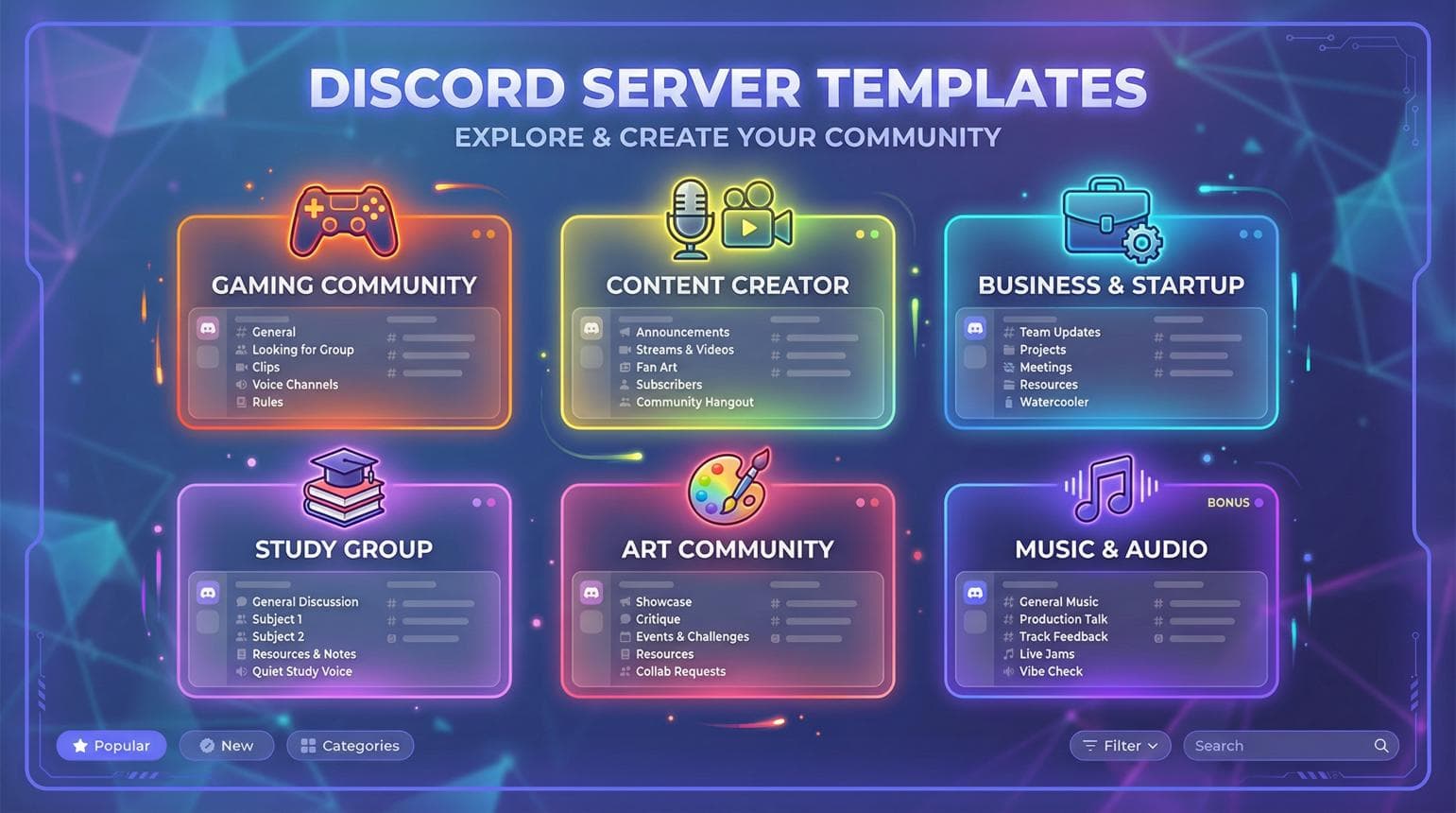
Gaming communities continue to shape Discord culture more than almost anything else.
Valorant teams, Minecraft SMPs, FPS clans, streamer squads, esports practice servers they all rely heavily on structure because communication speed matters.
A strong gaming template usually balances competition and casual interaction at the same time.
Welcome and rules section
Announcements and patch notes
General gaming chat
LFG channels
Clips and highlights
Voice rooms for squads and casual play
The strongest gaming servers also tend to include small social touches. Memes. Event nights. Community tournaments. Shared frustration after ranked losses. That sort of thing.
Because eventually people stop staying for the game alone. They stay for the regulars.
A few years ago, oversized “mega servers” were trendy.
Now? Smaller social layouts are performing surprisingly well because they feel less exhausting.
A good social or friend-group template usually keeps things intentionally lightweight.
#general-chat
#introductions
#memes
#music
#pets
One or two voice channels
That’s often enough.
Seriously.
One mistake server owners make is creating channels for conversations they hope will happen someday. Empty channels end up making servers feel inactive even if the community itself is healthy.
Conversation density matters more than channel quantity.
Study communities exploded over the last few years, especially among remote students, productivity circles, and competitive exam groups.
The interesting part is how emotionally supportive these servers have become. They’re no longer just about sharing notes.
Many successful study servers feel halfway between a classroom and a support group.
Study accountability channels
Resource libraries
Homework help rooms
Silent study voice channels
Pomodoro timers and productivity bots
The best study templates usually avoid overcomplicating aesthetics. Clean layouts help people focus mentally.
There’s also something oddly motivating about seeing other people studying in real time. Discord taps into that shared accountability really well.
Anime communities are chaotic in the best possible way.
The strongest anime server templates lean into identity and interaction rather than strict professionalism. People expect fun layouts, reaction roles, fanart channels, watch parties, and niche humor.
And yes, “waifu wars” channels somehow continue surviving every year.
Reaction roles based on anime fandoms
Manga discussion rooms
Fanart showcases
Watch party voice channels
Anime recommendation systems
Bots like Carl-bot and Mudae remain incredibly common because anime communities tend to enjoy collectible systems, custom roles, and interactive mechanics.
That said, even anime servers work better when channel counts stay under control. Too much visual clutter kills momentum surprisingly fast.
A lot of creator servers quietly fail because they become giant announcement boards instead of communities.
People don’t join creator Discords just to receive notifications. They join because they want proximity. Interaction. Recognition.
Good creator templates reflect that.
Video or livestream announcements
Fan discussion channels
Q&A spaces
Fan art and clip sharing
Subscriber or Patreon-only areas
The best creator servers also avoid making every interaction feel promotional.
Members can sense immediately when a Discord exists purely as a marketing extension. Communities become much stronger when creators occasionally hang out casually instead of appearing only to post updates.
Oddly enough, small unscripted moments often build more loyalty than polished content campaigns.
Professional communities have changed a lot recently.
Startup founders, SaaS companies, AI communities, Web3 groups, and tech teams increasingly use Discord as an actual operational space instead of just a side community.
That means templates need stronger moderation systems and cleaner information flow.
Announcements and updates
Support channels
Feature request systems
Networking sections
FAQ and resource libraries
Verification systems
Ticket systems also matter more in professional communities because support requests pile up quickly.
Still, the strongest business communities somehow manage to avoid feeling corporate all the time. That balance is difficult. But important.
Here’s something people rarely expect:
Many active Discord servers operate with surprisingly few channels.
Some of the healthiest communities online use:
5 10 text channels
2 4 voice channels
A simple role hierarchy
One or two moderation bots
That’s it.
Minimal layouts concentrate interaction. Which makes communities feel busier and more social.
People don’t join Discord servers hoping to admire organizational complexity. They join to connect with others.
Most server owners start with existing templates and customize them afterward.
Some reliable places include:
Discord’s official template gallery
Top.gg template sections
Discords.com
Community-driven template libraries
Though honestly, copying templates exactly rarely works long term.
The best communities eventually reshape layouts around how members naturally behave.
A template should be the starting point. Not the final personality of the server.
That’s probably the bigger lesson here.
The best Discord server templates don’t just organize channels. They quietly encourage interaction patterns.
Good layouts make conversations easier to start. Easier to follow. Easier to return to.
And in 2026, communities that feel approachable almost always outperform communities trying too hard to look impressive.
People remember energy more than aesthetics anyway.
So if you’re choosing a template, resist the urge to overbuild immediately. Start clean. Watch how members behave. Add complexity only when the community genuinely needs it.
That approach tends to age much better.
Ethnic Koti Editorial Team. (2026). "Best Discord Server Templates in 2026 for Gaming, Study, Creator, Anime, and Business Communities". Ethnickoti Blog. Retrieved from https://ethnickoti.com/blog/best-discord-server-templates-2026
Join the conversation. Be respectful and helpful.